Keeping the Peace Without Losing Yourself: How Muslim Women Manage Faith Across the Family Table
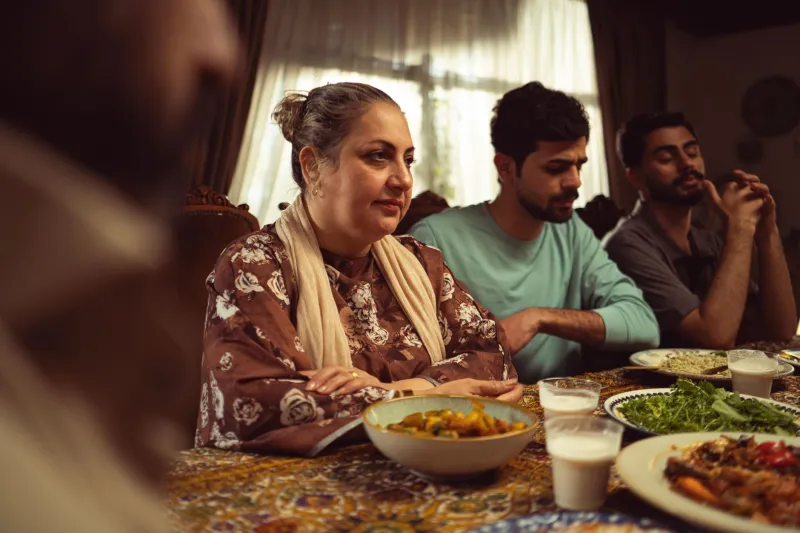
The Thanksgiving table at Rania's in-laws' house in suburban New Jersey has, over the years, become something of a diplomatic summit. There's the question of whether the turkey is halal (it usually isn't, so she brings her own dish). There's her mother-in-law's habit of offering wine before checking herself. There's her seven-year-old asking, loudly, why Grandpa doesn't pray like Mama does.
"I used to dread the holidays," says Rania, 36, who married her Irish-American husband eight years ago. "Now I kind of love them? It's messy and complicated and real. And we've built something together that I'm actually proud of."
Building that something — a life where faith isn't a wedge but a thread — is work that millions of Muslim women in the US are doing every single day. At the kitchen table, in the carpool, during Ramadan, during Christmas, during the completely ordinary Tuesday when someone says something that lands wrong. It requires patience, creativity, and a willingness to keep showing up even when the conversation gets hard.
The Interfaith Household: Love Doesn't Erase Difference
Let's start with the most obvious version of this dynamic: the interfaith marriage. Muslim women partnered with non-Muslim spouses — whether Christian, Jewish, atheist, or "spiritual but not religious" — navigate a particular kind of daily negotiation that rarely gets talked about honestly.
"People assume it's either totally fine or totally a disaster," says Yasmin, a 41-year-old physician in Seattle married to a non-practicing Catholic. "The truth is it's neither. It's just... ongoing."
Ongoing looks different for every couple. For Yasmin and her husband, it means he joins her for Eid celebrations and she joins his family for Easter — without either of them pretending to believe things they don't. For Rania, it means she and her husband agreed before marriage on how their children would be raised (Muslim, with exposure to his family's traditions). For others, the negotiation is more fluid and sometimes more fraught.
What the women we spoke with universally emphasized: communication early and often is non-negotiable. The couples who struggle most are the ones who assumed love would smooth over the specifics — and then found themselves blindsided by conflict over prayer schedules, dietary restrictions, or what to do when a child starts asking theological questions.
"We talked about everything before we got married," Rania says. "And then things came up that we hadn't talked about. And we talked about those too. That's just the deal."
When Your Own Family Is the Challenge
Not every faith tension in the home involves a spouse. For many Muslim women — especially those who are more observant than their families of origin, or who came to deeper practice later in life — the hardest conversations happen with parents, siblings, or extended family who don't share their level of commitment.
Fatima, 29, grew up in a culturally Muslim household in Michigan where prayer was occasional and hijab was not the norm. When she became more observant in her mid-twenties, her relationship with her mother became complicated almost overnight.
"She thought I was judging her," Fatima says. "I wasn't. I was just trying to figure out my own path. But she saw my choices as a critique of hers."
This dynamic — where increased religious practice reads as implicit judgment to less-observant family members — is incredibly common, and it cuts both ways. Women who become more secular also face pushback from more devout relatives. The direction of the shift matters less than the fact that it disrupts the family's established equilibrium.
Fatima's approach, after years of awkward holidays and tense phone calls, was to get very explicit about what she needed. "I told my mom: I'm not asking you to change. I'm asking you to respect that this is mine. That conversation was hard. It also saved our relationship."
Raising Kids at the Intersection
If there's one area where the stakes feel highest, it's parenting. Muslim mothers raising children in interfaith or religiously mixed households carry a particular kind of weight — the desire to transmit faith authentically while also raising kids who can navigate a pluralistic world without anxiety or rigidity.
"I want my kids to be proud Muslims," says Rania. "I also want them to love their grandfather, who goes to church on Sundays. Those things are not in conflict. But you have to be intentional about making sure they don't feel like they are."
Dr. Amira Saleh, a family counselor in the Chicago area who works extensively with Muslim families, says the key is giving children a strong internal foundation rather than a set of rules to defend. "When kids understand why they practice — the values, the meaning, the connection — they're much better equipped to engage with difference without feeling threatened by it."
She also encourages parents to normalize questions. "If your child asks why Grandma doesn't wear hijab or why Dad doesn't fast, that's not a crisis. That's curiosity. Answer it honestly and age-appropriately, and you've just done some of the best religious education possible."
Drawing the Line — And Knowing Where It Is
All this talk of bridge-building shouldn't imply that Muslim women are obligated to accommodate everything in the name of family harmony. Sometimes, keeping the peace comes at too high a cost — to your practice, your sense of self, or your children's wellbeing.
Yasmin describes a period early in her marriage when she consistently softened her practice around her in-laws to avoid making them uncomfortable. "I stopped praying when we visited. I didn't bring it up when they served pork. I was so focused on being likable that I kind of disappeared."
The turning point came when she realized her husband — who had always been supportive of her faith — was taking his cues from her. If she wasn't prioritizing her practice, he didn't know he should be helping to protect space for it. "I had to get honest with myself about what I actually needed, so I could ask for it."
Knowing your non-negotiables isn't rigidity. It's self-knowledge. And communicating them clearly — with love but without apology — is one of the most powerful things a woman can do for herself and for her relationships.
The Table Is Big Enough
What strikes us most, talking to these women, is how much love exists in the middle of all this complexity. Rania's mother-in-law, who once forgot not to offer wine, now keeps a bottle of sparkling cider in the fridge specifically for Rania. Fatima's mom showed up to her daughter's first Ramadan iftar dinner and brought store-bought baklava and a slightly chaotic energy that made everyone laugh.
None of it is perfect. All of it is real.
Faith, family, and the space where they meet — that's not a problem to be solved. It's a life to be lived. And Muslim women across this country are living it with more grace, grit, and humor than most people ever see.