Uncovering the Truth: What Happens When Muslim Women Choose to Pause the Hijab
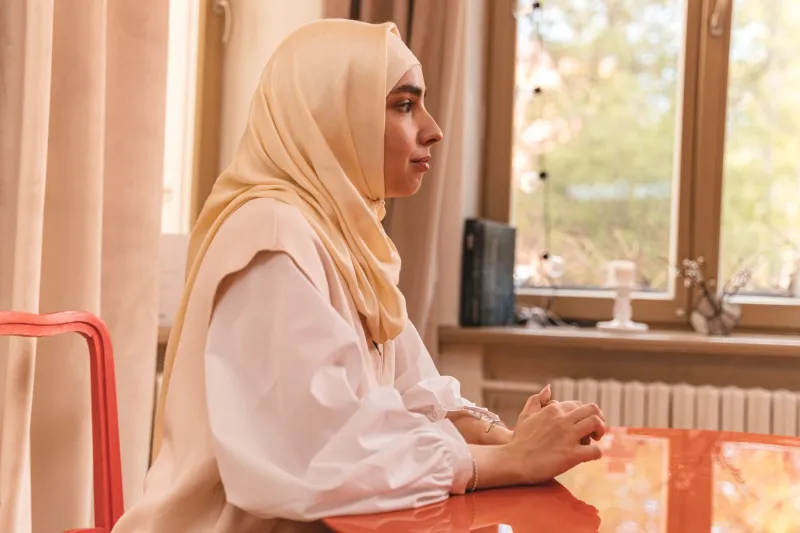
Nadia started wearing hijab at thirteen. By twenty-eight, she took it off for a weekend trip to visit college friends she hadn't seen in years. She put it back on Monday morning. Nobody knew. And yet, she says, that weekend changed everything about how she understood herself.
"I wasn't running from Islam," she tells us over the phone from her apartment in Atlanta. "I was trying to figure out where I ended and everyone else's expectations began."
Nadia's story isn't unique — it's just rarely told out loud. Across the United States, Muslim women are quietly, privately, and sometimes very publicly navigating what it means to take a break from covering. Whether it's a single afternoon, a few months between moves to a new city, or a longer, open-ended pause, these decisions are happening. And they deserve a real conversation — not a verdict.
More Than a Piece of Cloth
Hijab has always carried enormous symbolic weight — spiritually, politically, and culturally. In the American context, it's become something of a public statement, a marker of identity that the outside world reads and reacts to constantly. Post-9/11 Islamophobia made covering feel, for some women, like an act of defiance and pride. The modest fashion boom of the 2010s turned it into aesthetic expression. And social media transformed hijabi women into content creators, community leaders, and sometimes, unwilling representatives of an entire religion.
All of that weight adds up.
For some women, the decision to step back from hijab — even temporarily — is less about faith and more about bandwidth. "I was going through a divorce, starting over in a new state, and I just couldn't carry the visibility anymore," says Samira, 34, now living in Houston. "It wasn't that I stopped believing. I was just exhausted from being seen."
Others describe a more spiritual motivation — a desire to interrogate whether they were covering out of genuine conviction or inherited obligation. "I grew up in a household where hijab wasn't optional," says Leyla, a first-generation Somali-American in Minneapolis. "When I moved out at twenty-two, I needed to know: do I believe this? Or am I just following a script?"
The Community Pushback Is Real
Let's not sugarcoat it: the Muslim community's response to women who pause hijab can be brutal. Social media pile-ons, family estrangement, whisper networks at the mosque — the social consequences are very real and often very painful. Women describe losing friendships overnight, being subtly uninvited from community events, or enduring loaded questions from relatives who frame their concern as care.
"My aunt stopped talking to me for six months," Leyla recalls. "When she finally called, she said she was 'mourning' me. Like I had died. I was right here."
This kind of response, while understandable through the lens of deep religious conviction, often does more harm than good. It pushes women further away from community at exactly the moment they might most need connection. And it conflates outward practice with inner faith in ways that Islamic scholarship itself doesn't always support.
It's worth noting that Muslim scholars hold genuinely diverse positions on hijab — its obligation, its conditions, its interpretation. That's not a controversial statement; it's a historical fact. Women navigating these questions aren't necessarily rejecting Islam. Many are engaging with it more seriously than they ever have.
Identity Isn't a Binary
One of the most persistent myths about Muslim women and hijab is that it's all-or-nothing. You either wear it fully and always, or you've "left." But the reality of lived faith is messier, more human, and frankly more interesting than that.
Dr. Hana Khalil, a therapist based in the Chicago area who works with Muslim women navigating religious identity, puts it plainly: "Faith is not a performance review. It's a relationship. And like any relationship, it has seasons."
She sees clients who describe taking breaks from hijab as part of a broader process of owning their spirituality — moving from a faith they inherited to one they chose. "For many second-generation American Muslim women especially, there's this renegotiation that has to happen. And sometimes that looks like stepping back before stepping more fully in."
That tracks with what Nadia experienced. After her weekend without hijab, she came back to it — but differently. "I cover now because I want to," she says. "That shift is everything. I'm not performing modesty for my parents or my community. It's mine."
What "Modern" Islam Actually Looks Like
The phrase "modern Muslim woman" gets thrown around a lot, often by people who mean something very specific by it — usually, a woman who looks and acts more Western. But modernity for Muslim women isn't about removing the hijab any more than it's about keeping it. It's about having the internal freedom and communal support to make that choice authentically.
What's genuinely modern is the refusal to be defined entirely by external markers. It's the insistence on complexity. It's Nadia reclaiming her practice. It's Samira protecting her mental health. It's Leyla asking hard questions and staying Muslim through the uncertainty.
These women aren't cautionary tales. They're not lost. They're doing the deeply human work of figuring out who they are — and they're doing it while holding onto their faith, even when it doesn't look like anyone else's version of it.
Maybe the most Islamic thing we can do is make room for that.
Starting the Conversation
If you're a Muslim woman who has ever felt the pull to step back from hijab — or who has already done so — you're not alone, and you're not broken. And if you're someone in a woman's life who wants to support her through a faith transition, the most powerful thing you can offer isn't a lecture. It's a listening ear and a warm meal.
Community doesn't have to mean conformity. And love doesn't have to come with conditions.
The conversation is already happening — in DMs, in therapy offices, in late-night phone calls between sisters. It's time we brought it into the light.