Boardroom, Bold, and Covered: How Muslim Women Are Writing New Rules for Professional Beauty
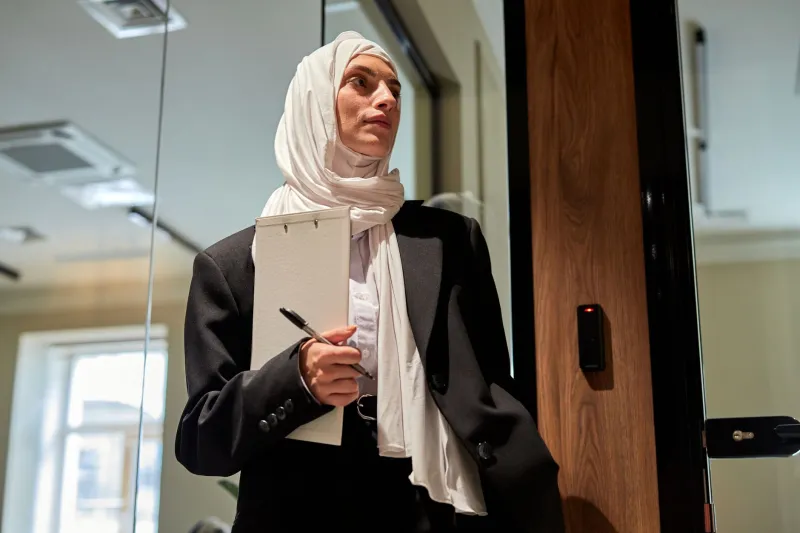
There's a moment Nadia Osman, a 34-year-old product director at a mid-size tech firm in Austin, knows well. It's the half-second pause when she walks into a conference room — the almost imperceptible recalibration on the faces of people who weren't expecting her. She's tall, sharp in a camel blazer, and her hijab is wrapped in a structured turban style that somehow manages to look both boardroom-ready and effortlessly chic.
"I stopped being nervous about that pause years ago," she says, laughing. "Now I kind of enjoy it. Because what comes after it is me running the meeting."
Nadia is part of a growing wave of Muslim women in the American workforce who are refusing the old binary: assimilate or get sidelined. Instead, they're showing up as their full selves — faith, fabric, and all — and in doing so, they're quietly dismantling what "professional" has long been allowed to look like.
The Unspoken Dress Code Problem
For decades, corporate beauty standards in the US were built around a very specific image: sleek, neutral, and — let's be honest — predominantly white. The idea that a woman in hijab could be the face of a brand, the head of a department, or the one closing the deal was treated as an exception, not an expectation.
That's changing. But it hasn't changed on its own.
Muslim women have been doing the work of reshaping perception from the inside out, one well-styled appearance at a time. Fatima Al-Rashid, a New York-based corporate attorney and founder of a Muslim women's professional network, describes it as "aesthetic activism."
"Every time I show up to a deposition or a client dinner looking put-together and covered, I'm making an argument without saying a word," she explains. "I'm saying: this is what competence looks like. This is what leadership looks like. Get used to it."
Fatima's personal style leans into structure — fitted blazers, jewel-toned hijabs in silk and crepe, minimal but intentional jewelry. She's meticulous about fabric quality because she knows people are paying attention in ways they wouldn't if she weren't visibly Muslim. "The bar is higher for us. I hate that it's true, but I'd rather dress knowing that and use it to my advantage."
Hijab Styling as a Skill — and an Art Form
One of the most visible shifts in the past five years has been the explosion of hijab styling creativity in professional contexts. Gone are the days when "work-appropriate hijab" meant a plain, tightly pinned square scarf in a muted color. Today's covered professionals are experimenting with voluminous wraps, tailored turbans, layered underlcaps, and fabrics ranging from structured jersey to fluid chiffon.
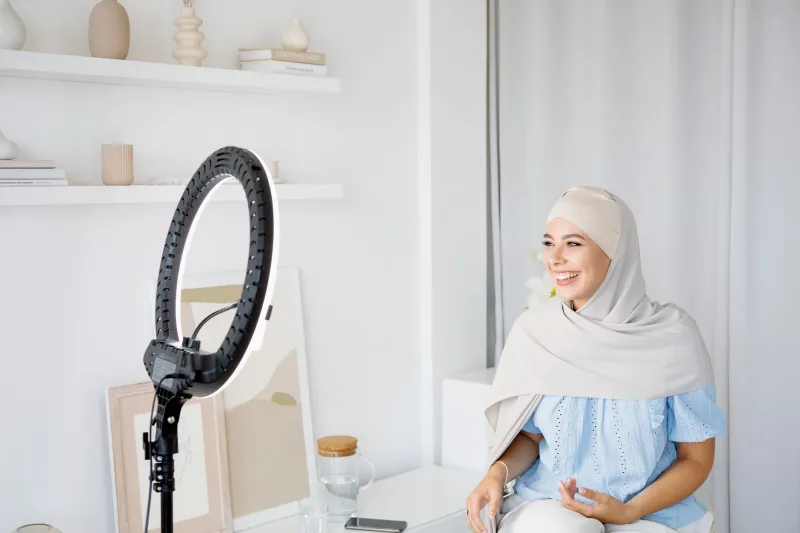
Beauty content creator and makeup artist Hana Yusuf, based in Chicago, has built a following of over 200,000 across platforms by specifically targeting the intersection of hijab and professional style. Her tutorials — titles like "Corporate Glam for Covered Girls" and "Interview-Ready Hijab Looks in Under 10 Minutes" — routinely outperform her lifestyle content.
"There was a gap," she says simply. "Women were searching for this content and not finding it. I just showed up."
Hana points out that Muslim women have had to become experts in a styling discipline that mainstream beauty culture has largely ignored. "We think about color theory, face framing, fabric weight, all of it — but applied to hijab. It's a whole skill set that nobody outside our community really credits us for."
Brands Are (Finally) Catching Up
The market is starting to notice. Brands like Veil, Haute Hijab, and a growing number of modest fashion lines are designing specifically for professional environments — think wrinkle-resistant fabrics, magnetic pins instead of traditional ones that snag on blazers, and color palettes that coordinate with neutral workwear staples.
Mainstream beauty brands, too, are slowly waking up. Fenty Beauty was praised early on for its inclusive shade ranges, and more recently, brands like Tower 28 and Rare Beauty have been embraced by Muslim beauty communities for their clean formulations — relevant for women who prioritize halal-certified or wudu-friendly products.
"I want a setting spray that doesn't break down during a long work day and holds through my afternoon prayer," says Nadia, laughing again. "That's a very specific ask. But it's also a massive, underserved market."
She's not wrong. Muslim consumers in the US represent billions in purchasing power, and the beauty and fashion industries are only beginning to understand what it means to genuinely serve — not just tokenize — this demographic.
Confidence as the Real Glow-Up
Ask any of these women what the biggest style shift has been, though, and the answer isn't a product or a trend. It's mindset.
"I spent years trying to make myself palatable," Fatima admits. "Smaller hijabs, more 'neutral' colors, always over-explaining my faith when people asked. At some point I just... stopped. And my style got so much better because I was finally dressing for me."
That internal shift — from dressing to minimize to dressing to express — is something Hana sees reflected in her community constantly. "The comments I get most often aren't 'thanks for the tutorial.' They're 'I finally feel seen.' That's what this is really about."
For Nadia, the boardroom pause has become something she's reframed entirely. "I'm not there to make anyone comfortable with my presence. I'm there to be excellent at my job. The hijab is just part of who I am. And who I am is really good at what I do."
That, right there, is the glow-up nobody saw coming — and nobody can take away.