One Woman, Many Wardrobes: The Real Lives Behind Muslim Women's Style Shifts
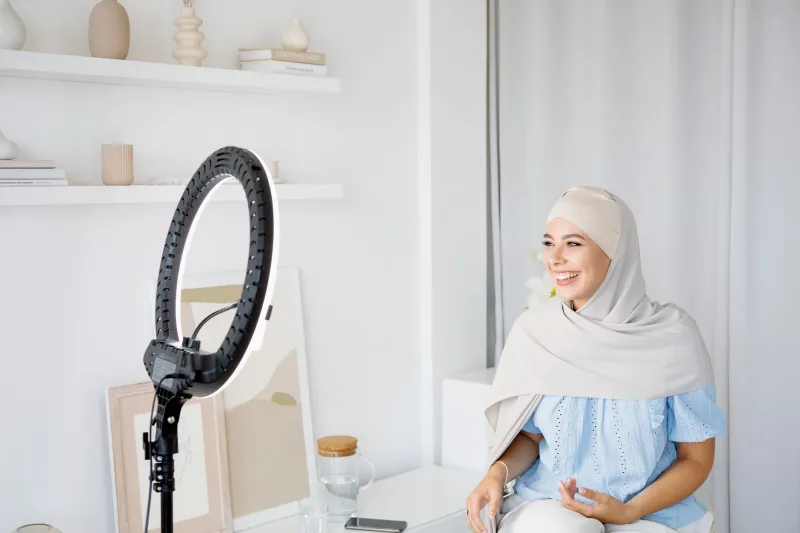
Picture this: It's 7:45 a.m. on a Tuesday. Nadia, a 34-year-old marketing director in Chicago, is standing in front of her closet making decisions that would exhaust a diplomat. She reaches for a structured blazer in dusty rose, pairs it with wide-leg trousers, and wraps a coordinated hijab in a clean, understated fold. Professional. Polished. Perfectly calibrated for a conference room full of people who have, on more than one occasion, asked her if she's "allowed" to wear color.
By Friday evening, that same closet will give her something entirely different — a flowy abaya in deep forest green for jummah prayers and a quick catch-up with her mother's side of the family. And come Saturday brunch with her college friends? A modest but unmistakably fun fit: an oversized vintage denim jacket, a printed maxi skirt, and a loosely draped scarf that leans more street style than strictly structured.
This is not an identity crisis. This is what it looks like to be a Muslim woman in America who has fully figured out her own style language — and speaks it fluently across multiple social dialects.
The Psychology of Dressing for the Room
Let's be honest: everyone code-switches in some form. You probably don't wear the same thing to your boss's retirement party that you'd wear to a backyard cookout. But for Muslim women — especially those who wear hijab or dress modestly as a visible expression of faith — the stakes feel different, more observed, and often more judged.
Dr. Yara Haddad, a cultural psychologist based in Dearborn, Michigan, who works primarily with Muslim American women, describes the phenomenon as "layered self-presentation." "It's not about being fake in different spaces," she explains. "It's about knowing which parts of yourself to foreground and which to hold closer depending on the environment. That's actually a sophisticated social skill — but it can also be genuinely exhausting when it feels like the burden falls entirely on you."
For many Muslim women, the exhaustion is real. There's a particular kind of mental labor that goes into dressing for a workplace where your modest aesthetic might be misread as either a political statement or a sign that you're somehow less modern, less ambitious, less American. The result is a kind of strategic styling — choosing pieces that read as authoritative and fashion-forward enough to silence any assumptions before they're even spoken.
Boardroom to Block: What Professional Modest Dressing Actually Looks Like
The American workplace has come a long way on dress code inclusivity — but it still has far to go. Muslim women navigating corporate environments often describe a balancing act: looking modest enough to feel authentic to their values, while also looking "polished enough" to be taken seriously in spaces that still, consciously or not, associate professionalism with Western silhouettes.
The good news? The rise of contemporary modest fashion has made this easier than it's ever been. Brands like Banana Republic and J.Crew have quietly become go-to sources for longline blazers, wide-leg trousers, and turtleneck layers that work beautifully with a hijab. And the explosion of modest-specific brands — from Vela Scarves to Aab Collection — means there are now actual options built with Muslim women's needs at the center.
Safia, a 28-year-old attorney in New York City, describes her work wardrobe as "quietly defiant." "I wear things that are completely modest but also completely fashion," she says. "A camel wool coat, tailored everything, a silk hijab. I want to walk into a room and have people think 'she has incredible taste' before they think anything else about my religion."
The Community Dress Code (Unwritten, but Extremely Real)
If the workplace demands one kind of fluency, the community context demands another — and sometimes they pull in opposite directions. Many Muslim women describe navigating mosque events, family gatherings, or community dinners with a different set of unspoken rules: more coverage, more traditional silhouettes, sometimes an expectation of a particular cultural aesthetic depending on your family's background.
For South Asian Muslim women, that might mean incorporating a shalwar kameez or salwar suit into rotation for family events — even if their everyday style leans more toward contemporary modest Western wear. For Arab American women, it might mean leaning into a more formal abaya for mosque occasions even if their personal style is decidedly more casual.
"There's a generational layer to it, too," says Amira, a 31-year-old from Houston whose Egyptian American family has what she lovingly calls "strong opinions" about appropriate dress at family functions. "My mom doesn't necessarily care what I wear to work — that's my world. But if I show up to Eid dinner in something she thinks is too casual, there's a whole conversation. It's not malicious, it's just... the community expectation."
Navigating that expectation without resentment — or without fully abandoning your own aesthetic — is its own art form.
The Weekend Self: Where Personal Style Gets to Breathe
Here's the part nobody always talks about: the version of your wardrobe that exists purely for you. The weekend fits. The brunch outfit. The "running errands but make it cute" ensemble that has nothing to prove to anyone.
For many Muslim women, this is where personal style really lives — in the spaces between professional obligation and community expectation. It's where you'll find the bold prints, the unexpected color combinations, the thrifted finds that don't fit neatly into any category except "this felt right."
This is also, increasingly, the space that modest fashion content creators are centering on social media — and it's resonating. Because it reflects something true: Muslim women's style isn't only about navigating external expectations. It's also about joy, creativity, and the very human pleasure of getting dressed in the morning and feeling like yourself.
Authenticity Isn't a Single Outfit
The idea that you have to dress the same way in every context to be "authentic" is one worth interrogating. Authenticity isn't a single aesthetic — it's a consistent relationship with your own values. And for Muslim women who dress modestly as an expression of faith, that consistency can absolutely coexist with a wardrobe that shifts, adapts, and expresses different facets of who they are.
Nadia, back in Chicago, puts it simply: "I'm not a different person at work than I am at the masjid or at brunch with my friends. I'm just showing up in the version of myself that makes sense for that moment. My hijab is always there. My values are always there. The blazer just changes."
Honestly? That sounds less like code-switching and more like mastery.