Dressed for Herself: How Muslim Women Are Owning the Modest Fashion Narrative
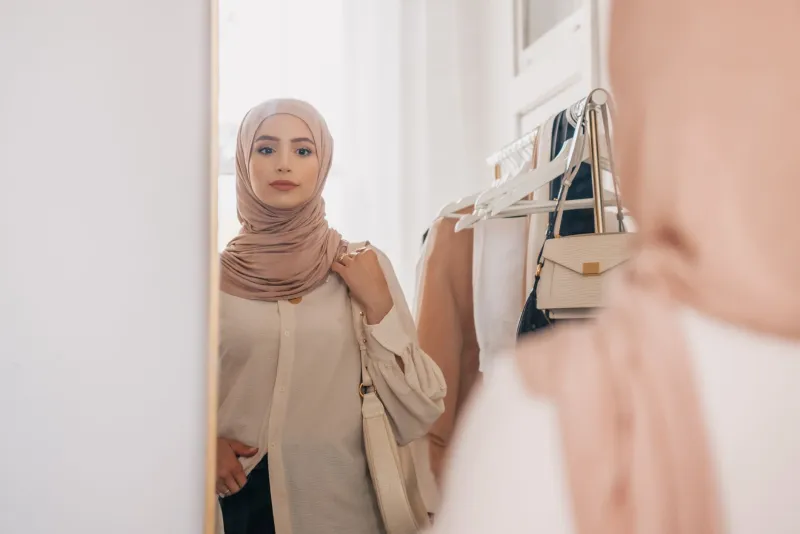
There's a moment a lot of Muslim women know well. You're standing in front of your closet, and before you've even reached for a hanger, the mental checklist starts. Will this read as too Western to my aunties? Will my coworkers think I'm being too conservative? Will the guy I'm seeing think I'm trying too hard—or not hard enough? It's exhausting. And increasingly, women are deciding they're done with it.
This isn't a story about abandoning modesty. It's about something more radical: deciding that modesty belongs to you.
The Audience Problem
Dr. Leila Haddad, a licensed clinical psychologist based in Chicago who works extensively with Muslim women, has a name for the mental gymnastics so many of her clients describe. She calls it "the audience effect"—the way we unconsciously perform our identity for an imagined crowd.
"Muslim women often come to me carrying this layered weight," she says. "They're dressing for their parents, for their community, for non-Muslim coworkers who might have assumptions, and sometimes for strangers who feel entitled to an opinion. At some point, there's no room left for what they actually want."
The audience effect isn't unique to Muslim women, of course. But the particular intersection of religious expectation, cultural pressure, and Western beauty standards creates a kind of triple bind that's genuinely hard to untangle. Add in social media—where your outfit is a public statement the moment you post it—and the noise gets even louder.
What's changing, according to Haddad and the women she works with, is a growing refusal to let the audience win.
Reclaiming the "Why"
Nadia Osman, 31, a marketing director in Atlanta, spent most of her twenties adjusting her wardrobe based on context. Hijab for family gatherings. A more "polished" look for client meetings she worried might make her seem less credible. Trendier pieces for weekends when she wanted to feel like she fit in with her friend group.
"I realized I had, like, five different wardrobes and none of them were really mine," she says, laughing. "I was curating myself for every room I walked into. It was creative in a way, but it was also really depleting."
The shift came after a conversation with her therapist about boundaries—not physical ones, but psychological ones. "She asked me, 'What would you wear if literally no one was watching?' And I couldn't answer. That freaked me out."
Nadia spent the next several months doing what she calls a "closet reset"—not a Marie Kondo purge, but a values audit. She asked herself not just what she liked, but why she liked it, and whether that reason came from inside or outside. The result was a wardrobe that actually felt coherent. More importantly, it felt like her.
What Scholars Are Saying
The idea that modesty should be internally motivated rather than externally enforced isn't new—it's actually deeply rooted in Islamic theology. Imam Yasmin Saleh, a scholar and educator based in the Washington, D.C. area, is quick to point this out.
"The Arabic concept of haya—often translated as modesty—is fundamentally about an internal state of consciousness," she explains. "It's about your relationship with God, with yourself, and then with others. When we reduce it purely to clothing rules policed by other people, we've actually missed the spiritual core of the teaching."
She's seen a meaningful shift in the questions young women bring to her. A decade ago, most questions were about rules: What's allowed? What's not? Now, she says, the questions are more nuanced. They're asking about intention, about authenticity, about how to honor their faith while also honoring their own evolving sense of self.
"That's a more sophisticated conversation," Imam Saleh says. "And honestly, it's a more Islamic one."
Style as Self-Determination
For some women, reclaiming their gaze has meant leaning further into modest fashion—not because they feel pressured to, but because they've discovered genuine joy in it. Fatima Khalil, 27, a graduate student in Los Angeles, started a small styling account on Instagram not to build a following but to process her own relationship with her wardrobe.
"I grew up feeling like modest fashion was a limitation," she admits. "Like I was working around something. And then I found this whole world of women who were treating it like an art form. Long silhouettes, layering, color theory—it's genuinely creative."
For others, the journey looks different. Some women have moved away from hijab, or chosen to wear it differently than they once did. Some have embraced bolder colors or more fitted cuts within their own personal definition of modesty. The common thread isn't a specific aesthetic—it's the decision-making process behind it.
Dr. Haddad puts it plainly: "When a woman can articulate why she's making a choice—and that reason is genuinely her own—there's a psychological groundedness that follows. She's not performing. She's expressing."
The Ripple Effect
Here's what's interesting: when women start dressing for themselves rather than for an imagined audience, it doesn't stay contained to their closets. Nadia noticed it first in her career. "I stopped shrinking in meetings. I stopped second-guessing whether I looked 'professional enough.' Because I'd already decided what professional meant to me."
Fatima saw it in her dating life. "I used to worry about whether a guy would see my hijab and make assumptions. Now I kind of appreciate that it's a filter. If someone can't see past it, that's useful information."
This is the modesty paradox in action: the more these women stopped performing for external audiences, the more visible and powerful they became—on their own terms.
Giving Yourself Permission
None of this is simple, and no one's pretending it is. Family dynamics are real. Workplace bias is real. The social weight of being visibly Muslim in America in 2024 is very real. The goal isn't to pretend those pressures don't exist—it's to stop letting them be the primary author of your choices.
Dr. Haddad suggests a starting point for women who feel tangled up in the audience effect: "Just notice. Before you get dressed, ask yourself who you're dressing for today. You don't have to change anything yet. Just get curious about the answer."
Because the truth is, the most powerful thing about modest fashion was never the modesty itself. It was always the intentionality behind it. When that intentionality belongs to you—not your family, not your community, not a non-Muslim coworker with opinions—that's when it becomes something genuinely yours.
And that, it turns out, is the whole point.