Swiping Right on Your Own Terms: How Muslim Women Are Rewriting the Rules of Romance
Let's be honest: the conversation around Muslim women and dating has always been a little... loaded. On one side, you've got the assumption that we're all waiting around for a family elder to hand-select a husband. On the other, there's this equally exhausting narrative that any Muslim woman who wants romance is somehow in conflict with her faith. Neither story is true. And a growing number of Muslim women in the US are done letting either one define them.
What's actually happening — in group chats, in therapy sessions, on apps like Muzz and Salams, and yes, even on regular old Hinge — is far more nuanced, far more personal, and honestly, far more interesting.
The Apps Are Real, and So Are the Complications
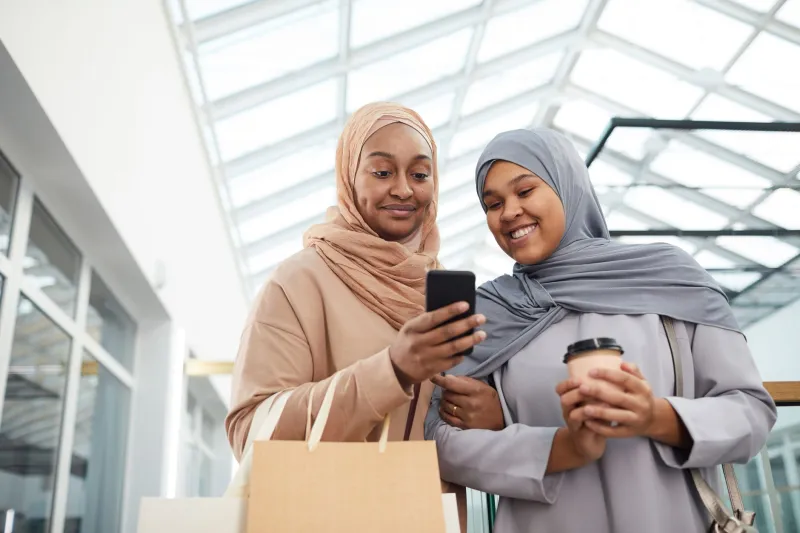
Nadia, 29, a marketing manager in Chicago, downloaded Muzz two years ago after growing tired of waiting for the "community pipeline" to produce someone she actually liked. "I knew what I wanted," she says. "Someone who prays, who has ambition, who can handle a woman with opinions. The app gave me a way to filter for the basics and then actually get to know someone without a whole family watching."
But even purpose-built halal dating apps come with their own friction. Nadia describes navigating men who list themselves as "practicing" but expect her to be available at midnight, or who bristle when she sets a timeline for meeting in a public place. "The platform being Muslim-focused doesn't automatically mean the men on it have done the inner work," she says with a laugh. "You still have to do the vetting."
That vetting — figuring out who someone actually is before emotions run too deep — is something Muslim women have quietly gotten very good at. Call it spiritually-informed discernment. Call it self-protection. Either way, it's a skill.
Redefining What "Halal" Actually Means in This Context
Here's where it gets complicated, and also where it gets really good: there is no single agreed-upon definition of halal dating among Muslim women today. For some, it means no physical contact before marriage, full stop. For others, it means being honest about intentions, involving family at an appropriate stage, and maintaining emotional integrity throughout. For others still, it's a deeply personal framework built from their understanding of Islamic ethics, their cultural background, and their lived experience.
Safa, 33, a nurse practitioner in Houston, grew up in a Pakistani-American household where rishtas — formal family-facilitated introductions — were the expected path. She went through several of them in her late twenties, sitting across from strangers in her mother's living room while aunties hovered nearby. "It wasn't terrible," she admits. "But I always felt like I was auditioning. Like the goal was to seem agreeable, not to actually connect."
Eventually, Safa started being more upfront — in the rishta process itself — about who she was. She told one family early on that she intended to keep working full-time after marriage. Another time, she brought up her views on raising kids with a balance of cultural and Islamic values, rather than strict tradition. Some families walked away. One didn't. She married that man last spring.
"Halal, to me, meant being honest," she says. "Not performing a version of myself to get a ring."
The Family Factor: Support System or Pressure Cooker?
Family involvement in Muslim courtship is one of those topics that deserves way more than a hot take. For many women, family is genuinely a resource — a built-in filter, a source of wisdom, a safety net. For others, family expectations become a source of anxiety that makes the whole process feel impossible.
Amira, 26, a graduate student in New York, describes her mother as her "hype woman" in the search for a partner. "She's on Salams too, lowkey," Amira laughs. "She'll send me profiles like, 'Look at this one, he has a beard and a master's degree.' It's chaotic but I love that she's invested."
But Amira is also clear that the final call is hers. "My mom can flag someone, but she doesn't get a vote. I think that boundary took a while for both of us to understand, but we got there."
Not every woman has that kind of relationship with her family. Some are navigating serious cultural pressure to marry within a specific ethnicity or background. Others are dealing with parents who are suspicious of any man a daughter brings home independently, because the very act of meeting him herself feels transgressive to them. These tensions are real, and they don't resolve neatly.
What many women are doing, though, is finding ways to honor their families while also honoring themselves — communicating early, setting expectations, and refusing to let the fear of conflict keep them from pursuing what they actually want.
Setting Boundaries Without Apology
One of the most radical things a Muslim woman in the dating space can do right now is be clear. Clear about her timeline. Clear about her dealbreakers. Clear about what she needs from a partner emotionally, spiritually, and practically.
This sounds basic. It is not basic. Many women — not just Muslim women — have been socialized to soften their needs, to make themselves easier to love by making themselves smaller. In a dating context where there's already external pressure to be a "good Muslim girl," that impulse can get even louder.
But the women we spoke to are pushing back. They're saying, in first conversations and in their app bios and in family meetings, exactly what they're looking for. They're walking away from men who can't handle directness. They're treating their own time and emotional energy as valuable — because it is.
"I used to think I had to be gentle with men's egos to keep them interested," says Nadia. "Now I think: if he can't handle me being straightforward, he definitely can't handle me being his wife."
Writing a New Story
The narrative around Muslim women and romance is shifting — slowly, imperfectly, but unmistakably. Women are holding tradition and autonomy in both hands at once, figuring out what each means to them, and refusing to choose between faith and desire.
That's not a contradiction. That's actually very Muslim. Islam has always asked its followers to engage thoughtfully with the world, to use reason, to act with intention. Applying that same thoughtfulness to how you find a life partner? Sounds about right.
Whatever your approach — rishtas, apps, community connections, or some combination of all three — the most important thing might be this: know what you value, say it out loud, and don't apologize for it. The right person will meet you there.