You Can Pray Here, But Can You Belong Here? The Hidden Loneliness of Mosque Life
She drives twenty minutes to Friday Jumu'ah, finds a spot in the sisters' section, prays with a hundred other women, and drives home alone. No one asked her name. No one invited her to stay for chai. She scrolled through her phone on the way back, half-hoping someone from the masjid had texted — knowing they hadn't, because they didn't have her number.
This isn't a story about a woman losing her faith. It's a story about a woman who showed up, fully, and still left feeling like a stranger.
If this sounds familiar, you're not imagining it — and you're definitely not alone.
The Paradox Nobody Talks About
There's this assumption baked into Islamic community life that the mosque is inherently a place of brotherhood and sisterhood. And spiritually? It often is. The act of standing shoulder to shoulder in prayer, of reciting the same words, of sharing the same qibla — there's a real, tangible sense of unity in that. But unity in worship doesn't automatically translate into friendship in the parking lot.
For Muslim women in the US especially, the gap between spiritual belonging and social belonging at the mosque can feel enormous. You might feel genuinely moved during khutbah and then spend the entire post-prayer mingling period standing slightly off to the side, cup of tea in hand, wondering how everyone else seems to already know each other.
The truth is: many of them do. And that's part of the problem.
The Clique Culture Nobody Wants to Admit
Let's be real for a second. Mosque social dynamics can be just as layered — and sometimes just as exclusionary — as any high school cafeteria. There are the founding families who've been attending since the building was a converted warehouse in 1987. There are the aunties whose social networks are so tightly woven that new women can't find an entry point. There are the younger second-generation women who have their own friend groups that formed in Sunday Islamic school and never really expanded.
None of these groups are being malicious. But the effect on newcomers, converts, or even longtime attendees who don't fit neatly into any existing circle can be quietly devastating.
Amani, a 29-year-old convert in the Chicago suburbs, described it this way: "I took my shahada at my mosque. They cheered. They hugged me. And then over the next six months, I realized that the warmth I felt that day was kind of... ceremonial. When I came back the following Sundays, nobody really checked in. I had to work so hard just to get someone to have coffee with me."
Language, Culture, and the Unspoken Sorting
Another layer that doesn't get enough airtime: the way language and ethnic culture quietly sort women into separate social universes within the same building.
Many mosques in the US serve congregations that are majority South Asian, Arab, West African, or Somali — and while that diversity is genuinely beautiful, it can also create invisible walls. Conversations happen in Urdu, Arabic, or Somali. Cultural references and humor don't always translate. Events are sometimes planned with one community's traditions in mind, leaving other women feeling like guests at someone else's family gathering.
For Black American Muslim women — who make up a significant portion of the US Muslim population but are often underrepresented in mosque leadership — this can feel especially acute. Showing up to a mosque where the dominant culture isn't yours, and where that's never acknowledged, takes a particular kind of resilience.
The Generational Divide Is Real
Add a generational gap to all of that, and you've got a social environment that's genuinely difficult to navigate. Older women at the mosque often have a vision of what sisterhood looks like that was shaped by a different era — showing up to each other's homes, cooking together, attending every life event. Younger women, many of whom are juggling careers, grad school, or young kids, are looking for something that fits differently into their lives: a group chat, a Saturday brunch, a book club that occasionally reads something Islamic.
Neither vision is wrong. But when they collide without any acknowledgment of the difference, women on both sides end up feeling misunderstood.
So What Do We Actually Do?
Here's where we get practical, because venting about the problem is only useful if we're also building toward something better.
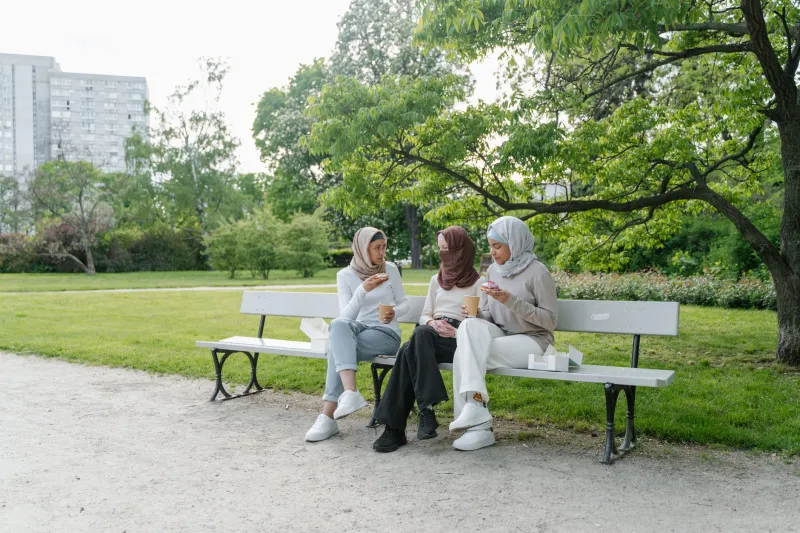
Start smaller than you think you should. Big mosque-wide events can feel overwhelming if you're already feeling invisible. Look for — or create — smaller gatherings. A group of five women who meet monthly for dinner is worth more to your sense of community than attending every large event alone.
Be the one who asks first. It feels vulnerable, and that's exactly why most people don't do it. After salah, introduce yourself to someone new. Ask for a number. Follow up. The discomfort is temporary; the friendship might be lasting.
Push your mosque to create structured connection points. Random mingling doesn't work well for people who don't already have an "in." But a structured new-member welcome program, a mentorship pairing between older and younger women, or a convert support circle? Those create natural entry points. If your mosque doesn't have these things, advocate for them — or build them yourself.
Find your people outside the main prayer hall. Islamic classes, volunteer programs, community service initiatives — these settings naturally create shared purpose, which is one of the fastest routes to real friendship. If your mosque offers these, show up. If it doesn't, look at regional Muslim organizations, online communities, or even social media groups for Muslim women in your city.
Give grace — to yourself and others. Sometimes the aunty who didn't say hello was having a terrible week. Sometimes the clique that looks impenetrable is just a group of women who are equally afraid of rejection. Approaching mosque social life with curiosity instead of guardedness doesn't mean being naive — it means giving connection a fighting chance.
The Mosque We Deserve
The vision of the masjid as a true community hub — a place where women know each other's names, celebrate each other's milestones, and show up in hard times — isn't naive. It's actually deeply rooted in Islamic tradition. The early Muslim community wasn't just a congregation; it was a network of genuine care and accountability.
We're allowed to want that. We're allowed to name it when it's missing. And we're allowed to be the ones who start building it, one awkward introduction and one honest conversation at a time.
The loneliness that so many Muslim women feel at the mosque isn't a personal failure. It's a community design problem — and community design problems can be solved. But only if we're willing to talk about them openly, which, honestly? Starts right here.