Desire, Covered and Uncensored: Muslim Women Are Rewriting What It Means to Feel Beautiful
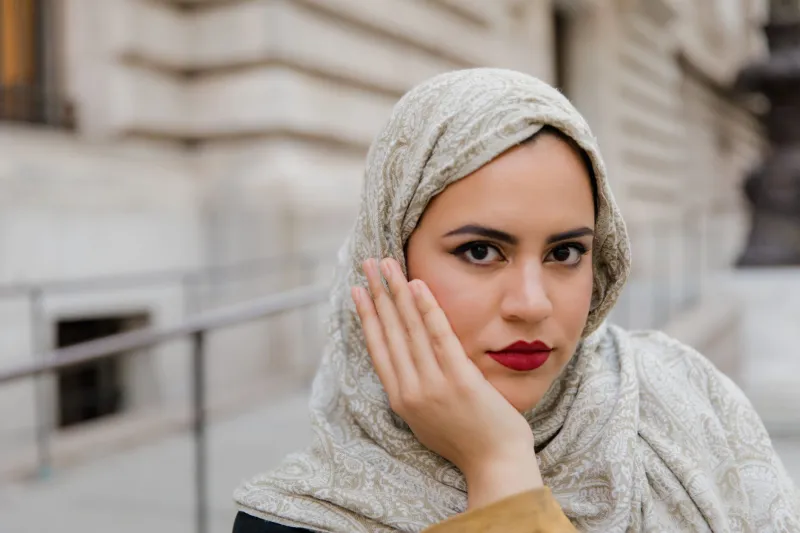
Let's get something out of the way first: covering your body does not mean erasing yourself.
For years — honestly, for decades — Muslim women have been squeezed between two impossible narratives. On one side, a Western gaze that reads hijab as oppression and modesty as the absence of desire. On the other, a community standard that sometimes treats femininity like a liability, something to be minimized, contained, apologized for. Neither story is true. And a growing number of Muslim women in the US are done living inside either one.
"I spent so long thinking I had to choose," says Nadia, a 29-year-old graphic designer in Chicago. "Either I'm modest and I shrink myself, or I'm confident and suddenly I'm 'too much.' But that's a false choice. I can wear a hijab and walk into a room like I own it. Those things are not in conflict."
They never were. But unpacking why that myth persists — and what Muslim women are doing to dismantle it — takes a little digging.
The Myth of the Desireless Covered Woman
Western pop culture has, for a long time, conflated visible skin with sexual power. The logic goes: if you're covered, you've opted out of desirability. You've made yourself invisible. But that framing puts the entire burden of sensuality on exposure — which is, if you think about it, a pretty reductive take on what makes a person magnetic.
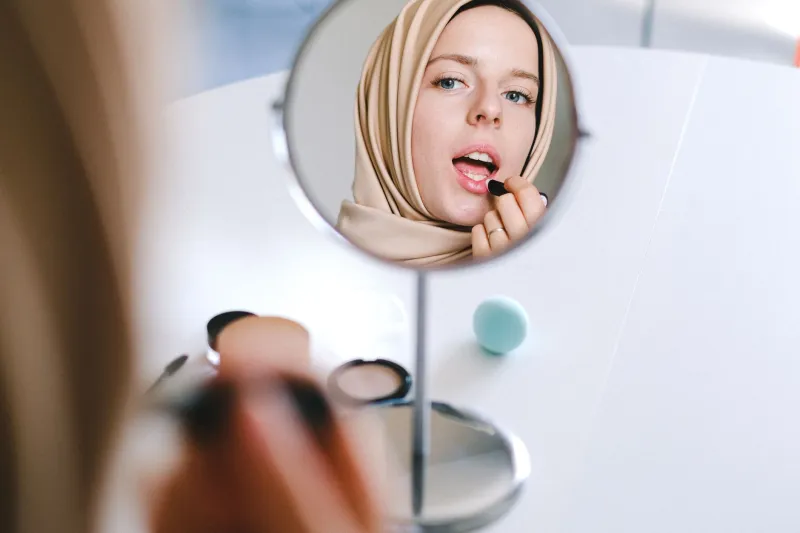
Muslim women know this. Many of them have always known it. Confidence radiates from how you carry yourself, the precision of your eyeliner, the way you laugh, the deliberateness of your personal style. None of that disappears under a headscarf.
"Modesty, for me, was never about hiding," says Amira, a 34-year-old attorney in Houston. "It was about controlling who gets access to me. That's actually incredibly powerful when you think about it. I decide what you see. That's not oppression — that's agency."
The reframe here is significant. Modesty, understood through that lens, isn't a subtraction. It's a form of curation. It's choosing.
Style as Spiritual Expression — Not Suppression
Scroll through the feeds of Muslim women in the US fashion space and you'll notice something: they are not dressing to disappear. The silhouettes are dramatic. The color palettes are bold. The styling is intentional and sometimes genuinely avant-garde. Modest fashion, as a category, has exploded — and not because women are settling. It's because they're demanding more.
Fatima, a 26-year-old content creator based in New York, built a following of over 80,000 people by doing exactly one thing: dressing like herself. Layered textures, statement outerwear, head wraps styled with the precision of a runway look. "People kept telling me modest fashion was limiting," she says. "And I kept thinking — limiting compared to what? I have an entire universe to work with."
Her feed is a direct rebuttal to the idea that covered women are aesthetically constrained. More than that, it's a rebuttal to the idea that their clothing choices are anyone else's business to evaluate.
This is where the conversation gets layered. Because the pressure doesn't only come from outside the Muslim community. There are internal voices too — the ones that equate any visible pride in one's appearance with vanity, or that treat a woman's enjoyment of fashion as spiritually suspect. Muslim women are navigating both directions at once.
"I've had people from my own community tell me I dress 'too nicely,'" Amira says, laughing. "Like my abaya is too fitted, or my colors are too bright. And I just think — where does that come from? That's not in the Quran. That's culture, and it's specifically about controlling women."
Desire Isn't the Opposite of Deen
Here's the part that often gets left out of these conversations: Islam has never actually been anti-desire. Islamic scholarship has a rich and nuanced tradition around sexuality, intimacy, and the body — one that acknowledges pleasure as something legitimate, even sacred, within its proper context. The idea that a Muslim woman must be desireless, or must perform desirelessness to be considered devout, is a cultural overlay, not a theological one.
That distinction matters enormously to the women living it.
"My faith doesn't ask me to stop being a woman," says Zainab, a 31-year-old therapist in the Bay Area. "It asks me to be intentional. There's a huge difference. I can want to feel beautiful. I can want my husband to find me attractive. I can enjoy getting dressed in the morning. None of that contradicts anything I believe."
Zainab works with Muslim women in her practice who are unraveling years of internalized shame around their own bodies and desires. "A lot of what I see is women who've been taught that wanting to feel desirable is haram, full stop. And that's just not accurate. It's also really damaging."
Reclaiming the Gaze
Perhaps the most radical thing contemporary Muslim women are doing is refusing to dress for anyone's comfort but their own. Not for the Western observer who wants them to uncover. Not for the community elder who wants them to shrink. Not for a husband, a mother, an algorithm, or a trend cycle.
For themselves.
"I put on my hijab because I believe in it," Nadia says. "And I style it the way I want because I'm a person with taste and a point of view. Both of those things can be true at the same time."
That duality — faith and self-expression, modesty and confidence, covering and being fully, undeniably present — is not a paradox. It's just what it looks like when women are allowed to be whole.
The culture is catching up, slowly. More brands are designing modest lines that don't feel like afterthoughts. More Muslim women are in front of cameras, behind microphones, on stages, in boardrooms. The visibility is shifting something.
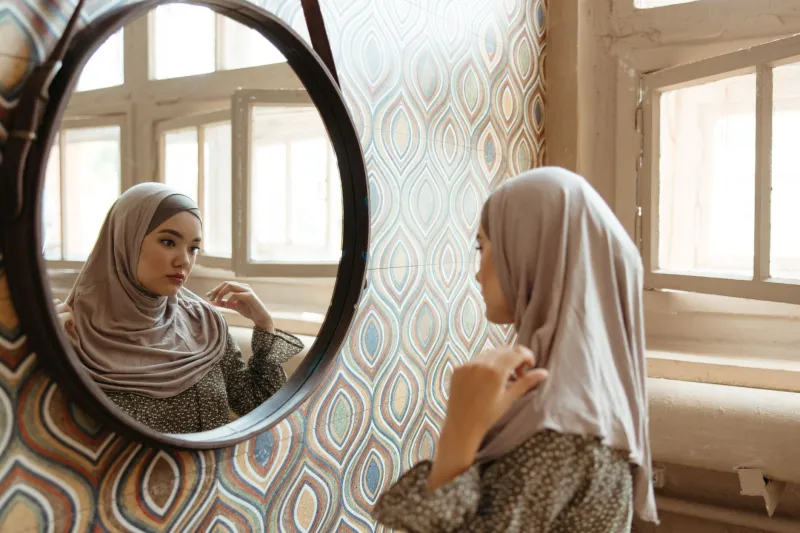
But the real shift is happening inside the conversation — in the group chats, the comment sections, the therapy rooms, and the quiet moments in front of the mirror where a Muslim woman looks at herself and decides, on her own terms, that she looks exactly right.
That's not a paradox. That's freedom.