Grief Has No Expiration Date: Muslim Women on Mourning in Their Own Time and Their Own Way
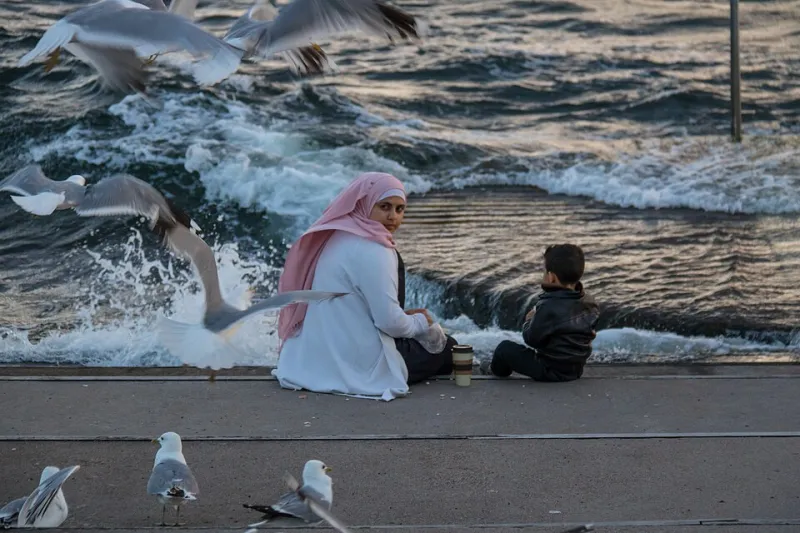
Photo: Susanne Nilsson, CC BY-SA 2.0, via Wikimedia Commons
Somewhere in the days after her mother died, Nadia — a 34-year-old teacher in Chicago — started keeping a mental tally of the things people said to her at the janazah and in the weeks that followed. She's in a better place. Allah doesn't give you more than you can bear. You have to be strong for your father. It's been three months — you should be feeling better by now.
Nadia isn't ungrateful for the people who showed up. She knows they meant well. But she also knows that none of those sentences actually touched the shape of what she was carrying. "Everyone had a script," she says. "And I didn't fit it."
She's not alone.
The Timeline We're Given and the One Grief Actually Follows
Islamic tradition does offer a mourning framework. Three days of condolences for most losses. Four months and ten days of iddah for a widow. The intention behind these structures is merciful — they create space for grief to exist without consuming a person's entire life indefinitely. They are not meant to be deadlines.
But in practice, many Muslim women describe feeling quietly pressured to perform recovery on a schedule. To stop crying at gatherings. To return to routines before they're ready. To frame their ongoing grief as a spiritual failing — as insufficient tawakkul, insufficient trust in Allah's plan.
This is a misreading of the tradition, and it does real harm.
The Prophet ﷺ wept at the death of his son Ibrahim. He wept for Khadijah years after she died. He described grief openly, without shame, and without anyone suggesting he should be over it. The Quran itself holds the image of Yaqub (Jacob) weeping so intensely for his son Yusuf that he lost his sight — and that story is told not as a cautionary tale about excessive emotion but as a testament to the depth of a father's love.
Islam does not ask you to be unmoved. It asks you to remain anchored while you move through the storm.
The Losses That Don't Come With Casseroles
Not all grief announces itself with a death. And the losses that don't come with a funeral — the ones without a formal name — are often the hardest to process in Muslim communities, because there's no ritual to hold them.
The grief of a marriage that ended in divorce, especially when you didn't want it to. The grief of infertility, of empty cycles and quiet heartbreaks that you carry alone because it's not a topic anyone brings up at the masjid. The grief of leaving a faith community that no longer feels safe. The grief of an identity you outgrew — a version of yourself you thought you'd be forever.
These losses are real. They deserve space. And the absence of a communal container for them doesn't mean you have to grieve them in secret.
When the Family Becomes Part of the Weight
For many Muslim women, grief is complicated by the expectation that they will also be the ones managing everyone else's grief. You're the daughter who keeps the household running while your father falls apart. You're the sister who holds the siblings together. You're the wife who maintains stability for the children while quietly dissolving inside.
This is an enormous and often invisible labor, and it has consequences. Grief that gets deferred — pushed down so you can function for other people — doesn't disappear. It relocates. It shows up as anxiety, as numbness, as a low-grade sadness that you can't quite explain years later.
You are allowed to grieve for yourself even when others need you. Those two things can coexist. Asking for support is not weakness, and it is not un-Islamic — the Prophet ﷺ actively encouraged the community to care for each other in times of loss, and that care was meant to flow toward you too.
The Spiritual Tools That Actually Help (And the Ones That Get Weaponized)
Islamic tradition offers genuine comfort for grief — inna lillahi wa inna ilayhi raji'un, the recognition that we belong to Allah and return to Him, is not a platitude. When it lands in the body rather than bouncing off the surface, it can be genuinely orienting. Salah, when grief makes it hard to find words, can become a physical act of surrender that bypasses the need to explain anything. Dua in the dark, when no one else is awake, can feel like the most honest conversation you've ever had.
But these tools work when they're offered with gentleness, not deployed as a way to shut down emotion. "Make dua and you'll feel better" can be a beautiful invitation or a dismissal, depending entirely on how it's said and when. Spirituality at its best sits with grief rather than trying to argue it away.
If you're finding that your spiritual practices feel hollow right now — if you're going through the motions without feeling anything — that is also a recognized experience in Islamic scholarship. The concept of a heart that feels sealed or distant from Allah during hardship is not evidence of your unworthiness. It's evidence that you're human, and that grief does things to us that we don't fully control.
When the Grief Is Too Heavy to Carry Alone
There is still a stigma in many Muslim communities around seeking professional mental health support, and grief is one of the places where that stigma causes the most damage. Complicated grief — the kind that doesn't ease with time, that interferes with daily functioning, that begins to look like depression — is a clinical reality, and it responds to treatment.
Seeking a therapist is not a sign that your faith isn't enough. It is a sign that you understand Allah created humans to need each other, including trained humans who know how to hold pain professionally and compassionately. Many Muslim therapists across the US now practice with both clinical training and cultural competency — they understand the specific textures of grief in Muslim families, the silence around mental health, the way community expectation can complicate healing.
You can be deeply faithful and also need a grief counselor. These are not competing truths.
Permission to Grieve Without a Script
If there's one thing we want to offer you in this piece, it's this: your grief is not a problem to be solved. It is not evidence of spiritual weakness. It is not something you owe anyone a performance of recovery from.
You are allowed to cry at unexpected moments years after a loss. You are allowed to grieve a life you didn't get to live, a person you didn't get to become, a relationship that ended before it was finished. You are allowed to be angry at Allah and then return to Him. You are allowed to need more time than the community gave you.
The tradition, at its most honest, is large enough to hold all of this. And so are you.